

What Makes Communion So Special?
The Lord's Table is the Central Practice of the Church

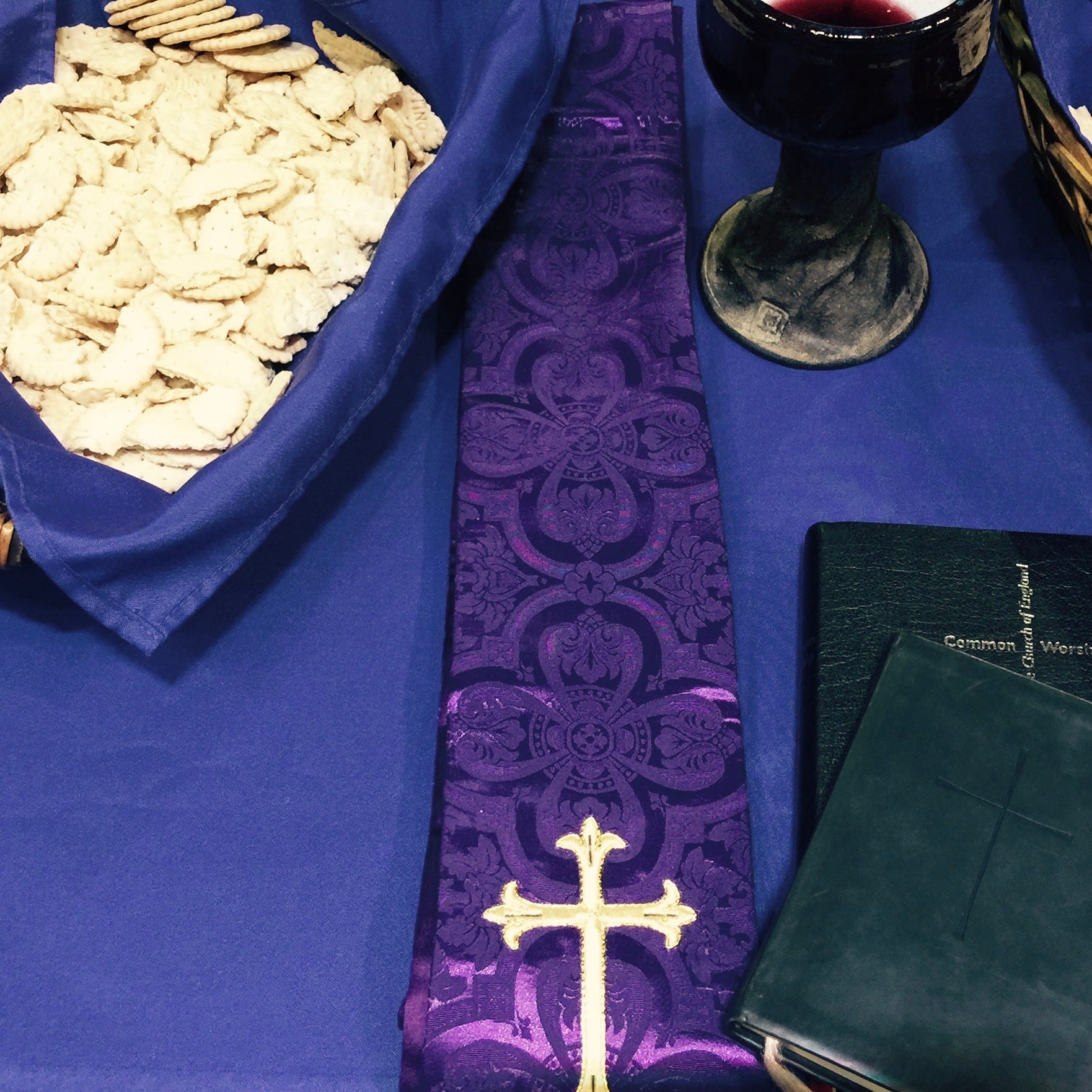
Isn’t Communion just “one of the ways” we worship and experience God? What makes it so special? What makes it the “container” for the “content” of God’s presence? Are the bread and cup really the body and the blood?
In order to shed a bit more light on Communion, may I take you on a little walk through church history? We’ll walk more quickly at first, but then slow down as we get to the Reformation. Grab your coat. We’ll start at the beginning.
When Jesus took the bread, gave thanks, broke it, and gave it to His disciples, saying “This is my body which is given for you”; and when He took the cup, gave thanks, and said, “This is my blood of the new covenant which is poured out for you,” He may not have known how the struggle over those words would divide His Church.
From the Early Church to the Middle Ages
Justin Martyr, a church leader in the second century, insisted in his First Apology on taking those words literally.1 What does “is” mean except, of course, is. (A closer examination of Greek syntax that shows that Jesus’s words could be rendered, “This, my body” and “This, my blood” came later.) From this early premise, theologians of the third and fourth century, like Cyril, Chrysostom, and Ambrose, began to suggest that the bread and the cup would undergo a “miraculous change.”2
Still, it was not until the Middle Ages that thinkers tried to explain how this change transpired. By the eleventh century, “theologians commonly spoke of a change in substance occurring in the bread and wine,” with the term transubstantiation coming into use later, around 1150.3 But it was not until the mid-1200s that the term and its accompanying tradition achieved its final form in the Latin or Western Church, thanks largely to the work of Saint Thomas Aquinas.4
With Aquinas leading the way, medieval theologians began the shift by saying that the Eucharist was not only an act of God infusing grace to the recipient, but also a “human response,” a sacrifice offered to God.5 Aquinas took this teaching to its logical conclusion in his Summa Theologica by calling the Eucharist a “sacrificial offering” in its own right, thus paving the way for the deeply embedded medieval view that “the Mass was itself a meritorious act.”6
The Reformers
It was to this medieval view of the Eucharist that the Reformers, beginning with Martin Luther, reacted most strongly. The Eucharist was not the cause of God’s grace; God’s loving nature is the cause for His grace. Nothing, not even our participating in the Eucharist, earns or merits grace. The Reformers also insisted that the Eucharist was not human work or sacrifice offered to God. Luther viewed the Eucharist as a sign of “God’s promise given to faith.”7 This notion of the Eucharist as a sign may have its roots in the Roman context for the Latin word sacramentum: an “oath of fidelity and obedience to one’s commander sworn by a Roman soldier upon enlistment in the army.”8 Augustine had developed this idea of the sacrament as an “outward, visible sign of an inward, invisible grace” centuries prior.9
So it’s not the cause of grace but a means of grace. But how? How is Christ present with us in the Eucharist? Here the Reformers were divided. Luther, the most “conservative” of the Reformers in terms of how much he wanted to preserve of the doctrines and practices of the Church, worked with the idea of transubstantiation, changing it in a small yet profound way. For Luther, Christ was not present in place of the bread and the wine but with the bread and the wine. In Luther’s view, the worshippers “ingest the Lord’s body and blood under and with the Communion elements, with the substance of the physical realities.”10
If Luther was the most conservative of the Reformers, then the most radical was likely Ulrich Zwingli. For Zwingli, Christ’s presence was not in the bread and wine at all. Rather, Christ is “spiritually present” with the gathered worshippers, just as Jesus promised to be present whenever “two or three gather” in His name.11 The focus was no longer on the words of institution from Christ—“This is my body, this is my blood”—but on His injunction to do this “in remembrance.” Thus, the Eucharist became for Zwingli a “memorial meal.” In American Christianity, I should note, we owe quite a bit of our heritage to Zwingli, for better or for worse, whether we know it or not.
John Calvin, a later Reformer, took a middle way. He agreed with Luther—and Catholic theologians—that Christ’s presence at the Eucharist is focused on the bread and the wine, but, like Zwingli, he did not think it was a physical presence. Christ is in heaven, but the “heavenly Christ meets the believer in the bread and wine” through the Holy Spirit.12
The English Reformers tended to take Calvin’s view, lopping off the extremes on either end: the Catholic “transubstantiation” and Zwingli’s “memorial meal.” Cranmer, the architect of the Church of England’s first Book of Common Prayer in 1549, leaned more toward Zwingli’s perspective—and the Swiss reformation with him. “This cup” must be taken figuratively, as a metaphor.13
Cranmer’s “subtlety” and “skill” can be seen in the prayers he curated for the Communion service. Editing an old prayer by adding a key phrase about Christ’s sacrifice “once offered,” he then expounded on it so as to leave no room for any need for another sacrifice—from Christ or from the worshipper—for another sin or sinner. And while the words in the Catholic rite proceed to make comparisons of the Communion elements to the cross, Cranmer subtly left it out, going right to a prayer to the Holy Spirit:
Hear us (o merciful father) we beseech thee: and with thy holy spirit and word, vouchsafe to bless and sanctify these thy gifts, and creatures of bread and wine, that they may be unto us the body and blood of they most dearely beloved son Jesus Christ.[i]14
Here Cranmer went beyond what Zwingli had done by emphasizing the role of the Holy Spirit. But he also, in Zwinglian fashion, made the presence of Christ something experienced by the worshipper—“that they may be unto us”—rather than something that existed objectively. Once again, this emphasis is not secondary. This shows that for Cranmer, “the place of transformation [was] not the sacrament itself but the heart of the believer.”15
There is one more word of note in Cranmer’s Book of Common Prayer. After each worshipper receives the bread and the wine, the priest leads everyone in the following prayer:
Almighty and ever-living God, we most heartily thank thee, for that thou dost vouchsafe to feed us, who have duly received these holy mysteries, with the spiritual food of the most precious Body and Blood of thy Son our Savior Jesus Christ; and dost assure us … of thy favor and goodness toward us; and that we are very members incorporate in the mystical body of thy Son, which is the blessed company of all faithful people….16
The words mysteries and mystical are used to describe the elements in general and the body of Christ in particular. One wonders if these words are meant to be a reference to the word used in the early Christian centuries for what we now call the sacraments. Because of the dominance of Greek in the early centuries, the Greek fathers appealed to certain New Testament texts that contain the word mysterion—like Ephesians 3:2–3—as the basis for calling these symbolic acts “mysteries” and not “sacraments.”17 While a sacrament may be a sign, a mystery involves room for something beyond what we can know.
In this prayer we find the best of the three traditions: the Catholic and Lutheran view of the Eucharist as a sign—sacrament; the Zwinglian view of the Eucharist as a memorial meal; and the Eastern Orthodox view of the Eucharist as a mystery.
Heres a 2-minute video I made in 2013 about why the Lord’s Table has been the centerpiece of Christian worship for 2000 years
(I looked different back then!)
What This Means For Us
The meal is a sign; the meal is a memorial; the meal is a mystery.
So how do we take on the sign and wear the pledge of faith? How do we participate in the memorial, the remembering? How do we enter this mystery?
We do so by partaking of the meal, the Lord’s Supper, Communion, the Eucharist, which means “thanksgiving.” For that reason, many churches call it “The Great Thanksgiving.” For God has come to do for us what we could not, to be for us what we cannot. We come with empty hands; He fills us with Himself. His body becomes our bread, our portion; His blood becomes our drink, our sustenance. His grace becomes more than enough.
Thanksgiving, indeed. Thanks be to God!
*This was an excerpt from a 2013 book I wrote called, Discover the Mystery of Faith: How Worship Shapes Believing.
Here’s a live version of a song I co-wrote with Jennie Lee Riddle based on the “Memorial Acclamation”— the climactic moment of the Anglican communion liturgy:
Justin Martyr, First Apology, trans. Thomas B. Falls (Washington, DC: The Catholic University of America Press, Inc., 1948), 105–106.
Stanley J. Grenz, Theology for the Community of God (Nashville, TN: Broadman & Holman, 1994), 532.
Grenz, Theology for the Community of God, 532.
Grenz, Theology for the Community of God, 532.
Grenz, Theology for the Community of God, 533.
Grenz, Theology for the Community of God, 533.
Grenz, Theology for the Community of God, 533.
Grenz, Theology for the Community of God, 513.
Grenz, Theology for the Community of God, 513.
Grenz, Theology for the Community of God, 534.
Grenz, Theology for the Community of God, 535.
Grenz, Theology for the Community of God, 535.
Brian Cummings, ed., The Book of Common Prayer: The Texts of 1549, 1559, and 1662 (Oxford: Oxford University Press, 2011), xxvii.
Cummings, ed., The Book of Common Prayer: The Texts of 1549, 1559, and 1662, xxx.
Cummings, ed., The Book of Common Prayer: The Texts of 1549, 1559, and 1662, xxx.
The Church of England, The Book of Common Prayer (Oxford: The Clarendon Press, 1815), 193.
Grenz, Theology for the Community of God, 512.
Sadly, we often approach Christ with our hands full of trinkets. He wants to bless us with something better, but our hands are full.
Glenn, the taxonomy you laid out here is exactly right, and it matters more than most people realize.
What gets lost in the sacrament vs. memorial debate is that both camps are reacting to something, not building toward something. Luther pushed back on merit. Zwingli pushed back on mystery. Cranmer tried to hold the tension. But when your theology is primarily defined by what you’re against, you end up with a practice that’s more about position than presence.
I served as an Assemblies of God pastor for 35 years. We sat firmly in the Zwinglian stream, often without knowing it. Communion was observed, not inhabited. It was correct, but it rarely felt weighty. It took me years to understand why. We had defended the memorial without recovering the mystery.
The frame that finally shifted things for me: the table is where theology stops being an argument and starts being an encounter. Sign. Memorial. Mystery. Not a spectrum to choose from. A simultaneous reality to step into.
Mid-career leaders, especially those who’ve led from a platform for years, often face this same collapse. They know what they believe about leadership. They’ve defended it. They’ve taught it. But at some point the framework stops feeding them. What Glenn is describing here applies far beyond ecclesiology. The thing that sustains long-term leadership isn’t certainty. It’s the capacity for mystery.